




missions project
we're doing at the moment
Central African Republic
Izabela Cywa
Safe Mom - we save newborns in CAR
potrzebna kwota:
271 000 zł
you donated:
4 915 zł
1%
last month: 16 492 zł
6%
334 863 zł
w sumie na ten projekt przekazaliście
Dear Donors and Friends of the “Safe Mom” Project!
We would like to thank you from the bottom of our hearts for your tremendous support and commitment. We are delighted to announce that the fundraising campaign for the next edition of the “Safe Mom” project has been a success. Thanks to your generosity, we have raised the funds needed to conduct the next round of training sessions in 2027. Thank you!
In Central African Republic women give birth at homes, often on the ground, without access to clean water, diagnostic tests, or basic equipment. In 95% of cases they don’t see a doctor even once thorough the whole pregnancy. Their lives are in the hands of matrons – local midwives with no medical training who base their knowledge on experience and tradition. It is little wonder, then, that the CAR has consistently occupied one of the highest ranks in the world in terms of maternal and peri-natal mortality rates for many years.
It was in this reality that the “Safe Mum” (“Bezpieczna Mama”) project was born. Its initiator is Izabela Cywa, a lay missionary from the Tarnów diocese who served as director of the hospital in Bagandou, CAR, for several years. Almost every day, she saw women arriving with severe complications from childbirth, often often when it was too late to help them.
Mothers and children were dying because no one had noticed the danger before or knew how to respond to it. In 90% of cases, midwives and those responsible for the delivery process are responsible for such high mortality rates in the CAR. They make mistakes because they are uneducated,
explains Iza.
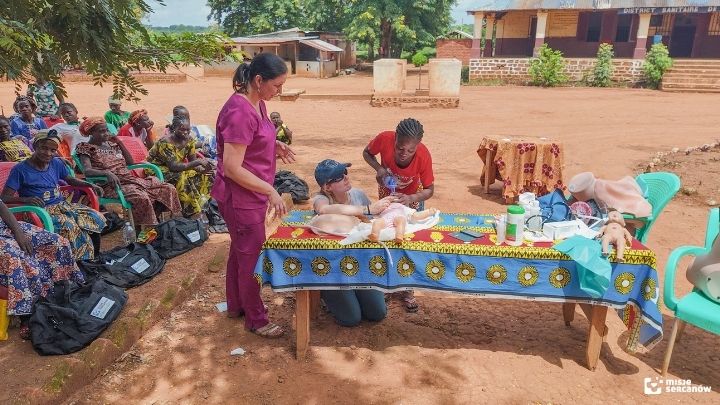
That is why the “Safe Mum” project focuses on the source of the problem – insufficient knowledge and lack of equipment among those delivering babies. Together with midwife Sara Suchowiak, Iza has created a specialized training programme in gynaecology and obstetrics. It covers, among other things, the detection of the most common pregnancy and perinatal pathologies, the management of postpartum haemorrhages, newborn resuscitation, postnatal care, and the ability to quickly refer patients to medical centres.
-1754379312.jpg)
At the same time, the project aims to provide medical centres with basic obstetric and gynaecological equipment – from stethoscopes for listening to the foetal heartbeat, through sterile umbilical cord clamps, to so-called “midwife backpacks” containing essential tools and hygiene products. This equipment is kept on site and continues to serve local communities even after the training has concluded.
To date, medical volunteers from the “Safe Mum” project have trained over 170 matrons in various regions of the Central African Republic. The effects are becoming increasingly noticeable. Reports from the CAR Ministry of Health show a clear increase in the early detection of pregnancy complications and in the number of women referred for tests and to hospitals. The change in the role of matrons is particularly significant. Thanks to training, they are not only becoming birth attendants, but also the first point of contact in the healthcare system. They are able to recognize symptoms such as fever, anaemia, or lack of foetal movement, and refer women to a medical centre in time. It is these decisions that save the lives of mothers and newborns.
For example, if postpartum haemorrhage occurs, a midwife trained by us already knows how to respond – she wraps a scarf around the mother's abdomen and immediately directs her to a medical centre. This really saves lives,
explains Iza.
The next, seventh edition of the project is planned for 2027. Year 2026 will be devoted to creating the first antenatal school in the Central African Republic, which will complement existing efforts by educating women on newborn care and postnatal care. “Safe Mum” is a long-term project – step by step, it is changing the reality of women who for years had no choice.
Support the “Safe Mum” project! Save the lives of women and children in the CAR!


poznaj inne projekty