




On May 24, we celebrate the World Day of Prayer for the Church in China. In China, it is the feast of Our Lady of Sheshan, the national Marian sanctuary in Shanghai. As we approach June, the month dedicated to praying the Litany to the Sacred Heart of Jesus, we invite you to read an article about the cult of the Sacred Heart in Asia.
The beginning of the cult of the Sacred Heart in China
Jesuit Father Jean Charles de Broissia (1660–1704) introduced devotion to the Sacred Heart in China (beginning in 1699). However, the spread of devotion to the Sacred Heart in China is mainly due to his confrere Romain Hinderer (1668-1744), who built the first large Sacred Heart church in the city of Hangzhou between 1722 and 1732.
The Divine Word Missionaries played a huge role in introducing the cult of the Sacred Heart of Jesus to China. They breathed devotion to the Sacred Heart. Among them, Saint Joseph Freinademetz (one of the first Divine Word Missionaries in Shandong Province) deserves special attention, as he referred everything to the Sacred Heart. It was significant for him that on 1 June 1881, in the month dedicated to the Sacred Heart, he set off on a journey from Hong Kong to Shandong, and on the 24th day of the same month, on the feast of the Sacred Heart, he arrived at his destination.
Currently, there are over 200 parishes, churches and chapels dedicated to the Sacred Heart of Jesus in mainland China. Among them is the cathedral of the Archdiocese of Guangzhou, perhaps the most beautiful of all cathedrals in China. New churches dedicated to the Most Sacred Heart of Jesus continue to be built, such as the church inaugurated in June 2023 in the Diocese of Wenzhou.
Forms of devotion to the Sacred Heart
There are many external manifestations of devotion to the Most Sacred Heart of Jesus. In homes and sanctuaries, the icon of the Most Sacred Heart is always present, bound with a crown of thorns, surrounded by flames of love, sprinkled with drops of blood and with a cross in the centre. These signs encourage us to remember God's eternal love for humanity, a love revealed in the life and death of His Son.
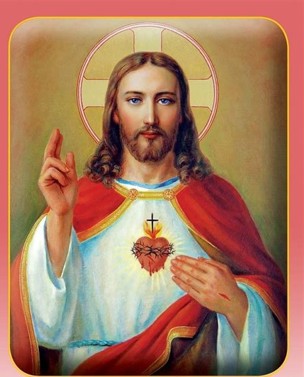
In this respect, the Church in China was not innovative. The icon was accepted as it is, although Chinese sensibilities shaped by "filial piety" might object to such a representation: the ideal of filial piety requires that after death, the body of a person be returned to their parents intact; the dismemberment of a dead body was considered the ultimate horror.
Catholic communities in mainland China are intensely celebrating June, dedicated to the Most Sacred Heart of Jesus, by undertaking various initiatives. Devotion to the Most Sacred Heart of Jesus is very strong in China and has been passed down from generation to generation. In addition to diocesan parishes and religious congregations, there are also many associations, groups and various types of Catholic institutions that have paid homage to the Most Sacred Heart by adopting its name. For example, the Sacred Heart Foundation of the Diocese of Ji Ning in Shan Dong Province. Their specific commitment is to serve poor families, disadvantaged children and the sick, Catholics and non-Catholics alike, in the name of the Sacred Heart. The foundation was able to help children return to school, support lepers who were marginalised and abandoned by their families, and visit the sick in hospital. In this way, thanks to the living witness of faith, charitable activity became a work of evangelisation.
Where the pace of life allows it – more often in the countryside than in cities – the faithful lead an almost communal spiritual life, which initially was a reflection of monastic or seminary life. Early in the morning, summoned to prayer by the sound of bells, they gathered, if possible, in a church or village chapel to say morning prayers together. It is a long prayer, abundant, generous, with many intentions and invocations. In June, dedicated to the Most Sacred Heart of Jesus, the Litany of the Sacred Heart is recited, followed by several pages of prayers dedicated to the Most Sacred Heart. After these prayers, which take about an hour, Holy Mass is celebrated if a priest is present. The faithful often continue their meditation with the Via Crucis.
In the past, Sunday was entirely devoted to communal prayer, and the faithful spent more time in church than at home. Evening prayer, again recited together, revisited the theme of the Most Sacred Heart, and again the faithful recited invocations and litanies. The texts of the prayers, introduced by missionaries in the past and recited in song, use a somewhat archaic form of Chinese that is incomprehensible to young people or those with less education. Several dioceses have books containing all the texts. But what strikes us Europeans is the fact that all prayers are recited from memory. In the past, since their childhood, all prayers were memorised.
In China, lay people consecrate their entire families to the Most Sacred Heart of Jesus, and priests celebrate the Day of Priestly Consecration on His liturgical feast day.
Iconography of the Sacred Heart
Images played an important role in evangelising China. Although there is probably no representation of the physical heart in Chinese art, the concept of the 'heart' occupies a central place in Chinese thought and feelings. The heart is the centre and source of all mental, cognitive and spiritual activities. In Chinese characters, all these operations or mental states have the symbol of the heart as their root or matrix. In dictionaries, one can find hundreds of these pictograms and countless expressions or proverbs that use the symbol of the heart as the key to their meaning.
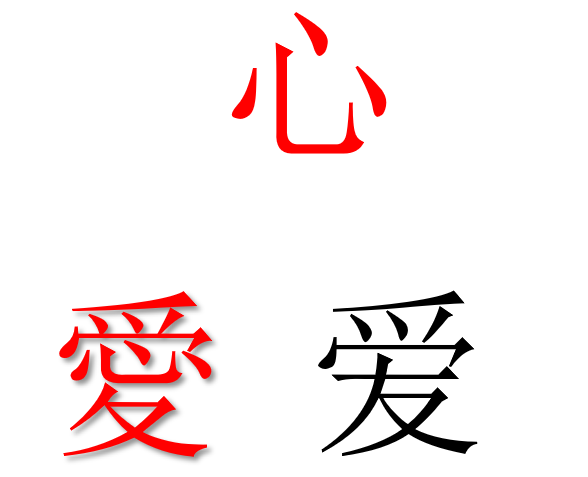
The Jesuit missionaries were well aware of the importance of pictorial writing, which is in fact the foundation of Chinese culture. Using European allegorical images, they were able to influence Chinese tradition and culture artistically and evangelically. They had learned the oil painting technique in Europe, which aroused the interest of Chinese literati at the imperial court.
There are Chinese manuscripts with Christian images dating back to around 1640, taken from the unique book “Kouduo richao” (Oral Admonitions). It is a record of conversations between the Italian Jesuit Giulio Aleni (1582-1649) and Andrzej Rudomina (1596-1631), a Jesuit of Lithuanian-Polish origin, with Christian disciples. It is an extremely valuable document illustrating the life and work of missionaries in Christian districts and showing how they adapted to such work.
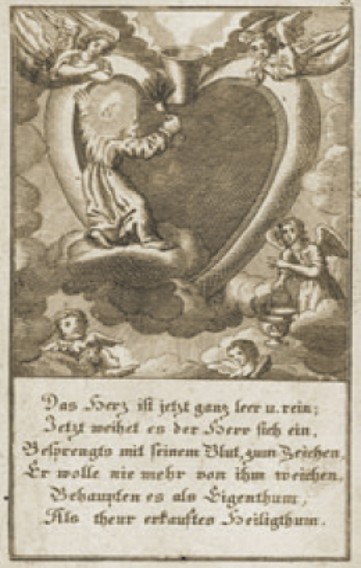
Andrzej Rudomina intrigued his Chinese audience with a new European concept of reflection on the Heart of Jesus, which plays an important role in Chinese philosophy as both mind and heart at the same time, without the division into intelectum and cor known from European tradition. It contains an intellectual and emotional concept. The mind-heart determines the balance between Confucian moral virtues on the one hand and emotions on the other. Emotions themselves are not negative per se, as mentioned by the schools of Neo-Confucianism.
The power of images, as already proven in Europe, has always been enormous. It was thanks to this power that the Jesuits had more effective tools in their work of evangelising China. In the image shown, we see Jesus cleansing the human heart with his Most Holy Blood. This salvific work is accompanied by angels serving Jesus – one of the angels holds a vessel with Blood, watching and adoring. As the inscription proclaims, the heart opens itself to the purifying action of grace, hiding nothing from its Saviour, because nothing can be hidden from Him. This was typical catechesis of Jesuit missionaries addressed to the Chinese.
The Most Sacred Heart and the martyrs
On the occasion of the canonisation of 120 Chinese martyrs in 2000, Pope John Paul II received an impressive work of calligraphy: since in China it was forbidden to mention, let alone depict, the martyrs who had been canonised (an event repugnant to the communists), the Chinese created a calligraphic work of the sign of "love" made up of 120 symbols, each slightly different, with the ideogram of "love" four symbols in size in the centre. The pictogram "love" has the symbol of a "heart" as its root or key. Each of the 120 symbols represents a martyr, and the large symbol in the centre represents Jesus: thus, 120 symbols of heartfelt love for the Heart burning with Love.
Devotion to the Most Sacred Heart of Jesus in China is a reality for devout Catholics, just as much as, if not more than, in all other regions of the Catholic Church around the world. Asking a Chinese Catholic if they are familiar with devotion to the Sacred Heart of Jesus is likely to offend them, as if one were questioning their orthodoxy and orthopraxy.