




As part of the “Help for the Holy Land” project, we provided humanitarian aid to Christians from Ain Ebel in response to the ongoing military operations in the region. We invite you to read an article about this Lebanese Christian village, caught in the crossfire of the conflict in the south of the country.
Location and Geography – a land shaped by history
Ain Ebel is a village in southern Lebanon, administratively part of the Nabatieh District in the Bint Jbeil region. It lies about 140 km from Beirut and roughly 25 km in a straight line from the Mediterranean coast. The village stretches across a hill at an elevation of 750 to 850 meters above sea level.
Its location is no coincidence. For centuries, it served as a strategic point along a trade route connecting Tyre with Damascus and Haifa. This position made it a meeting place of cultures and civilizations, as well as part of a natural chain of water sources extending toward Cana and further to the coast.
According to historian Joseph Toufik Khoreich, the name “Ain Ebel” means “Spring of the Monks,” derived from the Aramaic ain (spring) and ebel (hermit or monk). Other interpretations suggest that “Ebel” may be a distorted form of the name Baal, a Semitic storm deity, which would give the name the meaning “Spring of Irrigation.” In classical Arabic, the name is also interpreted as “Spring of Camels.”
The village is characterized by a Mediterranean climate with four distinct seasons. Autumn and spring are mild and rainy, winter is cold and occasionally snowy, while summer is dry and pleasant, with average temperatures ranging between 25–27°C.
The main agricultural products include olives, almonds, chestnuts, pecans, grapes, figs, pomegranates, and apples. The surrounding area is framed by oak and pine forests stretching along the outskirts of the village.
Origins – from the Canaanites to the Romans
Evidence of human activity in this area dates back to the Lower Paleolithic period. Stone tools discovered there point to early settlement and hunting activity. Archaeological remains from biblical times have also been found in the vicinity.
In antiquity, a temple dedicated to the Canaanite goddess Asherah – known as the “Mother of the Gods” – stood in Ain Ebel. In a sense, the spiritual continuity of this place endures to this day through the veneration of Mary, the Mother of God, the village’s patron, in whose honor annual celebrations are held in August.
-1776843430.jpg)
On the outskirts of the village, in the Shlaaboun area, the French historian Ernest Renan – working under the patronage of Napoleon III – discovered ancient burial sites and numerous archaeological structures. He described a landscape filled with underground corridors, stone constructions, and carved sarcophagi, linking these sites to the biblical town of Shaalabbin of the Tribe of Dan.
Among the discoveries was also a Phoenician-Roman temple dating to the 2nd–3rd century AD, dedicated to Apollo and Artemis (identified with Diana and Astarte). From one of the tombs, Renan recovered a bas-relief depicting these deities. It was transported to France and is now housed in the Louvre as an example of Phoenician-Roman art. In 2011, a replica was donated to Ain Ebel.
On the paths of the Gospel
Ain Ebel holds a special place on the spiritual map of the region. It lies between Lower Galilee and the so-called “Galilee of the Nations,” in the very heart of the lands traversed by Jesus Christ during his journeys between Nazareth, Tyre, and Sidon. The village is situated along a historic route of water sources that once connected Galilee with the Mediterranean coast. This route passed through Cana – the site of the miracle of turning water into wine – and then continued toward Tyre. As a result, Ain Ebel stands at the crossroads of important religious and cultural routes.
-1776843478.jpg)
Available sources indicate that the village has been continuously inhabited since at least the 16th century, when Christian settlers – mainly Maronites – migrated from northern Lebanon to cultivate the feudal lands of the south. This process intensified during the rule of Emir Fakhr al-Din II. He sent Maronite settlers to farm the land and secure the borders, making Ain Ebel one of the first pillars of his vision of a unified Lebanon and a symbol of the Christian presence in the south of the country. To this day, the vast majority of the village’s population remains Christian, predominantly of the Maronite faith.
With a population of around 5,000, the village was long considered one of the most agriculturally productive areas in the region. Oral traditions speak of a daily caravan of 40 camels departing for the port of Tyre, carrying agricultural goods – a powerful symbol of Ain Ebel’s economic importance.
Education and the role of the Jesuits
In 1888, the residents of Ain Ebel donated a large plot of land to the Jesuit Fathers, supporting their decision with a petition signed by nearly all inhabitants. This act reflected a strong commitment to education and close cooperation with the Society of Jesus.
Today, three schools operate in Ain Ebel – two private (Sacred Heart and Saint Joseph) and one public – rooted in this tradition. The Sacred Heart School, founded in 1881, is among the oldest in the region. Notably, Ain Ebel was also a pioneer of coeducation in the East, as the Jesuit school opened its doors to both boys and girls at a time when this was a bold and uncommon step – affirming the right to education for all and placing the village ahead of its time.
-1776843493.jpg)
The Blood That Shaped Greater Lebanon
After the end of Ottoman rule in 1918 and the transition to the French Mandate in 1920, the inhabitants of Ain Ebel clearly supported the annexation to Greater Lebanon, opposing the incorporation of the south into neighboring entities.
On May 5, 1920, amid rising regional tensions, a Shiite militia led by Mahmoud Bazzi attacked the village. More than 100 residents of Ain Ebel were killed. The villagers defended their community from dawn until dusk, until they ran out of ammunition.
A Franciscan document describing these events states that the attackers committed acts of extreme violence, sparing no one. The survivors fled south to Haifa, from where French ships transported them to Tyre. The village was completely destroyed, and the damage to two churches, a school, and a monastery indicated the religiously motivated nature of the attack. The neighboring villages of Debel and Rmaich also fell victim. Order was restored only after the intervention of French forces, 12 days later.
While awaiting their return to the village, reports emerged that a soldier serving in the British army had offered residents the sale of their property to Zionists, arguing that they had no guarantee of returning to Ain Ebel. However, all of them refused. This was another example of the pressure exerted on Christians in the Tyre district to leave their lands and emigrate from the region.
These massacres reinforced the Maronites’ belief that the entire region of Jabal Amel (a cultural-geographical area in southern Lebanon, encompassing mainly the mountainous lands on both sides of the Litani River, between the Mediterranean Sea to the west and the valleys of Wadi al-Taym, the Bekaa, and Hula to the east) should be incorporated into Greater Lebanon, whose borders were ultimately defined at the San Remo Conference in 1920.
Ain Ebel Today – Heritage and Future
We, the inhabitants of Ain Ebel, deeply believe in our mission and in at least two fundamental values: protecting life in border villages that do not know peace due to ongoing conflicts, and making life more humane and beautiful through our work.
Those who carry the message of Ain Ebel see themselves as messengers of hope and creators of positive change.
Ain Ebel is not just a point on the map. It is:
• a witness to history whose roots stretch back thousands of years,
• a spiritual gateway on Christ’s path between Galilee and Tyre,
• an archaeological treasure, part of whose heritage is preserved in the Louvre,
• a national symbol that paid in blood and dignity for the creation of Greater Lebanon,
• a pioneer in education, ahead of its time through the introduction of coeducation,
• a place at the crossroads of time and eternity, earth and heaven, heritage and future.
Edgard Barakat, Ain Ebel
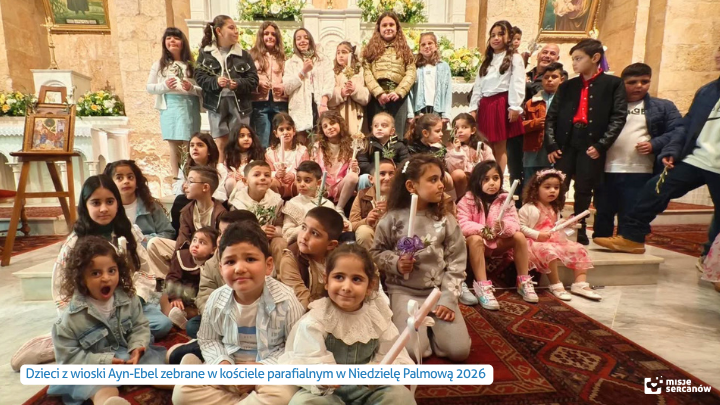
Ain Ebel lies just 7.5 kilometers from the Lebanese–Israeli border and is currently located in an area of IDF operations on Lebanese territory, where fighting with Hezbollah is taking place. Despite evacuation calls issued by the Lebanese government, 370 families have chosen to remain in their homes. At present, residents face serious difficulties in meeting their basic needs. There is a shortage of food and medicine, while damage to infrastructure has resulted in unstable supplies of electricity and water.
In cooperation with the Maronite Archdiocese of Antelias, we are delivering to Ain Ebel: rechargeable electric lamps that provide light under conditions of unstable power supply, fuel essential for the functioning of households (6 tons every 15 days), and medicines worth several thousand złoty per month.
Help us save not only people, but also the spiritual heritage of Christianity in the Middle East.


