




“Today our biggest concern is whether, in the event of an emergency evacuation of a sick person, the car will make it to the city or break down along the way. And if a delivery becomes complicated – where will the child be born?” asks Sister Iwona Korniluk, FMM, a missionary serving in Madagascar.
The Franciscan Missionaries of Mary have reached out to us with a request for help in purchasing a car for their community in Ambohinoarina – a mountain village of around 10,000 inhabitants.
A village not on the map
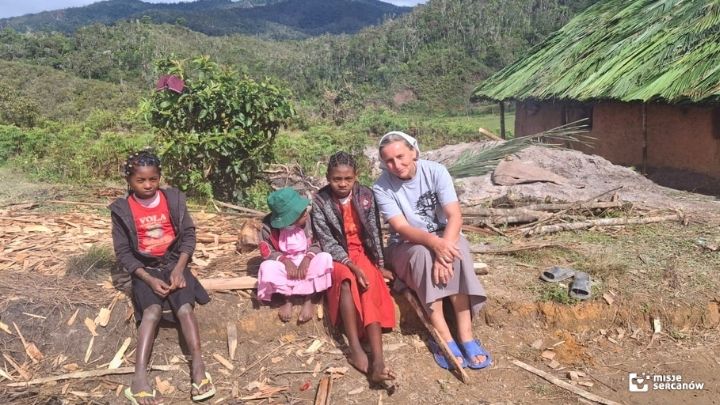
Although Ambohinoarina has as many residents as a small Polish town, it is almost impossible to find it on online maps. The houses do not form a compact settlement – they are scattered across the mountains, often one or two kilometres apart. Each family lives as close as possible to its rice fields and small vegetable plots, which provide their basic livelihood. Those who are better off build brick houses, while others use clay, wood, and whatever the forest provides. On the upper floor people live; below them – animals.
At an altitude of over 1,100 metres above sea level, the Franciscan Missionaries of Mary have been carrying out their mission for 50 years. Today, the community consists of six sisters – five Malagasy and one from Poland.
Close to the people
Their daily life is not limited to convent life. The sisters run a school from kindergarten through to secondary level, as well as a health clinic. They visit families scattered across the surrounding hills, pray with them, talk to them, and care for the sick.
Some settlements require a four-hour walk. The path leads through rice fields crisscrossed by irrigation canals. During the rainy season, mud reaches the ankles and slows every step. Along the way, the sisters pass people carrying sacks of rice or water on their shoulders.
“We sleep on straw mattresses wherever we are placed by our hosts, we eat what they prepare for us, and we suffer from the same insects that, without distinction, bite everyone. This helps us feel a real bond with the ‘forest people’, who every day struggle with cold, hunger, and long hours of walking,” the missionary explains.
Each visit to another village reveals a different fragment of local life. The sisters accompany the inhabitants during rice harvests, share their joy at successful yields, but also witness malaria, asthma, and diseases treated with herbs because medical help is too far away. Such treatment often leads to tragic consequences, and recovery can take months.
The road to the hospital
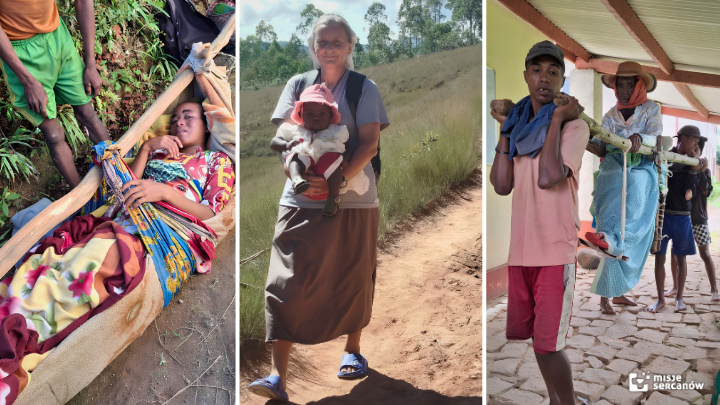
The nearest hospital is in Ambalavao, 45 kilometres from the mission. In Poland, such a distance takes less than an hour by car. Here, the journey lasts up to five hours by vehicle and around nine hours on foot. On the hottest days, temperatures reach 50°C. It is an immense effort even for a healthy person, not to mention someone who is ill.
That is why the car is one of the most important tools in the sisters’ work. It is not merely a means of transport. It is, in practice, an ambulance. It carries the seriously ill, women with complications during childbirth, and children in urgent need of medical care. It delivers medicines and allows access to places that would otherwise be unreachable.
Work in the rice fields is carried out with the help of bulls. They are indispensable, but dangerous animals. Accidents do happen and often end in tragedy. “We had to arrange for the evacuation to the hospital of a man who had suffered a lacerated abdomen – he had been attacked by a bull. His intestines were protruding from his body. His friends held his abdomen closed using banana leaves and string, since they didn’t have any bandages…” recalls Sister Iwona.
Increasingly, pregnant women also require urgent transport. The clinic has no ultrasound equipment, so not all complications can be predicted. When labour is prolonged or the baby is in the wrong position, every minute matters.
A plea for help
Meanwhile, the sisters’ car – one of only two in the entire village – is already 21 years old. The road to the city is full of deep ruts, rocks, and broken bridges. Almost every journey ends with another breakdown. “After driving down to the city, we often have to leave the car with a mechanic just so it can make the journey back up to the mission,” says Sister Iwona.
This creates a constant sense of anxiety. Not about comfort, but about whether the car will start at all. Whether it will reach a woman in labour. Whether it will get a seriously injured person to hospital in time.
On missions, a car is not a luxury. It is a tool for saving lives. “Therefore, we ask for help in purchasing this vehicle, which our community simply cannot afford, and which is an essential tool for our mission among the local ‘forest people’.”
A full overhaul of the old vehicle would be extremely costly and would not solve the problem for long. The community is therefore asking for support in purchasing a new, reliable car. Its total cost, including a 40% import duty in Madagascar, amounts to €41,000.


