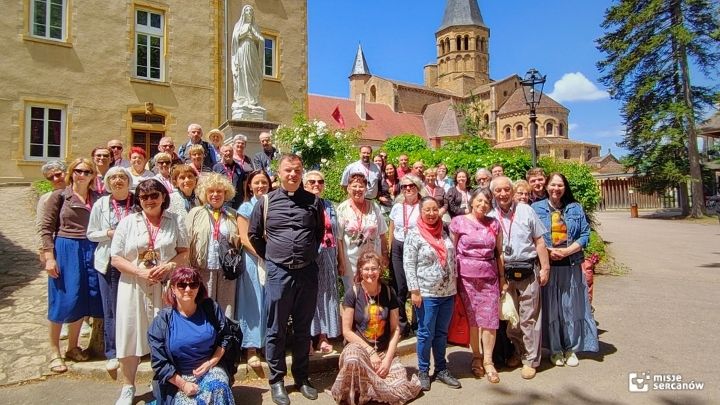


The answer lies neither in the number of shrines we visit nor in the photos we take along the way. It is found in the encounters, the prayer, and the experience that is difficult to put into words, yet easy to recognize once we return to everyday life.
“Why go on a pilgrimage when you could simply take a trip?” It is a question that comes up time and again. After all, the itinerary looks much the same: Lyon, Paray-le-Monial, La Salette, Laus, Turin, Milan, and Bergamo. You can admire magnificent basilicas, take photos overlooking the Superga hill, climb to the rooftop of Milan Cathedral, stroll through charming old streets, and return home with a camera full of beautiful memories.
You can.
But you can also return with something that no photograph could ever capture.
Our “Pilgrimage to the Heart of God” was precisely that kind of journey. From the very first evening – when, after arriving in Lyon, simply being together mattered more than sightseeing – to the final Holy Mass in Bergamo, each day reminded us that pilgrimage is not about traveling from one shrine to another, but about allowing God to guide our own hearts.
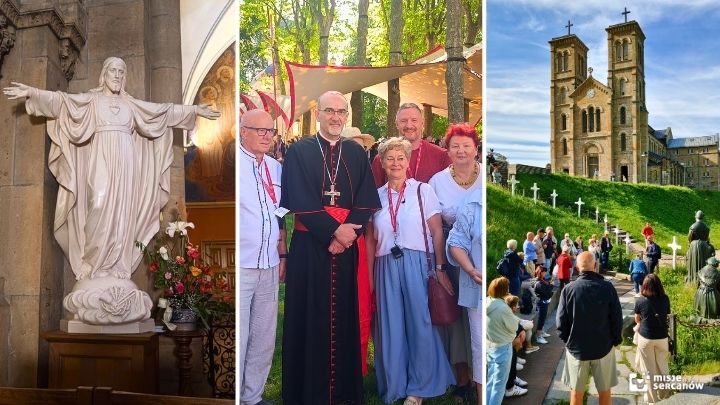
In Lyon, we visited places connected with Blessed Pauline Jaricot. In Paray-le-Monial, we took part in the feast celebrations in honor of the Most Sacred Heart of Jesus, at the very place from which the message of Christ's Heart overflowing with love for every person spread throughout the world. Later, Mary led us through La Salette and Laus. In Turin, we encountered St. John Bosco, prayed at the tomb of Blessed Pier Giorgio Frassati, and visited the cathedral that houses the Holy Shroud. In Milan, we were captivated by its remarkable architecture, but equally moved by the witness of young saints who show that the Gospel can still be lived fully today. Every day included time for prayer, the Eucharist, and moments of silence – and, in the end, it was these moments that proved to be the most important.
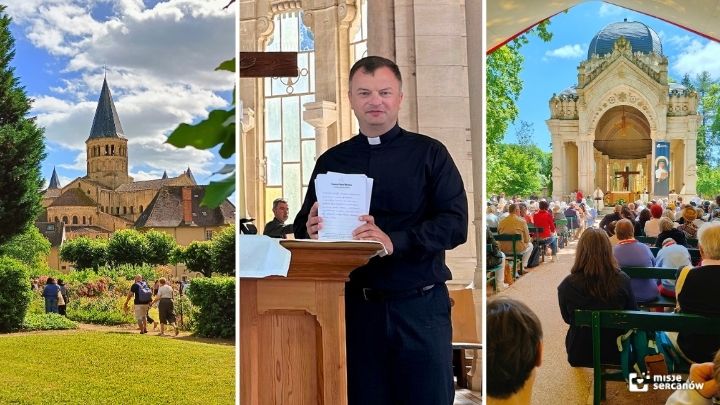
One of the most memorable moments of the pilgrimage was the celebration of the Eucharist in Paray-le-Monial. We were deeply blessed to participate in a Holy Mass celebrated by Cardinal Pierbattista Pizzaballa, OFM, the Latin Patriarch of Jerusalem. His presence meant far more than simply having a distinguished celebrant; it became a visible sign of our spiritual communion with Christians in the Middle East, who face suffering, war, and uncertainty every day. It was from him that we heard words that remained with many of us: that “in life and in love, one must be a little bit crazy,” and that we can come to Christ exactly as we are.
During this Eucharist, Fr. Piotr Chmielecki, SCJ, placed on the altar the intentions and prayers of thanksgiving that had been submitted beforehand to the pilgrimage office as part of the June Prayer to the Sacred Heart of Jesus. In this way, we journeyed not only with our own intentions. We carried to the Heart of Jesus the concerns, hopes, and gratitude of many people who remained at home yet were spiritually united with us. It was a beautiful reminder that a pilgrimage is never only about those who travel – it always carries with it the prayers of the whole community.
After returning home, Agata wrote that the pilgrimage had been, above all, a ”beautiful encounter with Jesus, Mary, and other people.” She recalled that ”our shared prayer, kind words, and everyday smiles were priceless gifts,” and that throughout the journey she felt like ”part of one big family.” I believe many of us would gladly make those words our own.
Because community is not born from extraordinary events. It grows out of a simple ”good morning,” singing together on the coach, praying during long journeys, conversations over dinner, shared laughter, and moments of silence experienced together in the shrines. As Agata wrote, ”It was precisely these simple, everyday moments that gave birth to a community, making each new day of the pilgrimage a beautiful lesson in faith, gratitude, and mutual kindness.”
The ”Pilgrimage to the Heart of God” also became a journey into the depths of one's own heart. Agata discovered that it was a time when she could ”put my phone away, ‘log out’ of the virtual world, and truly listen to the testimonies and stories of the people whom God had placed on my path.” Sometimes that is exactly what we need most – not more information, but genuine presence.
Halina set out on the pilgrimage inspired by the film ”The Sacred Heart.” In Paray-le-Monial, she was especially moved by the words of Cardinal Pierbattista Pizzaballa and by the reflections of our guide, Fr. Piotr Chmielecki, SCJ. Among the many thoughts she carried home, one resonated most deeply: ”The world is dying because it does not know that it is loved.” Another became a mission to live out upon returning home: ”We are going back to our homes, and we must bring God's love wherever we live. Today we have received the Heart of Jesus – we cannot keep this gift only for ourselves.”
Halina also noticed that throughout the pilgrimage two French expressions kept returning like a refrain: ”Je suis” and ”Sacré-Cœur.” ”’I am’ became for me a sign of the Lord's presence – not only in the places we visited, but also within me, in my own heart. And ‘Sacred Heart’ became the most beautiful expression of Love, in which each of us can discover what is most personal.”
Perhaps this is the best answer to the question of why we go on pilgrimage. A pilgrimage is not an escape from life. It is a return to what matters most.
Kuba admits that the beginning was not easy. ”Stepping outside my comfort zone, opening myself to new people, and talking with those whose life experiences were completely different from my own was a real challenge.” Yet this proved to be one of the greatest gifts of the pilgrimage. ”Every conversation brought something new, offered a different perspective on many things, and taught me to be more open.”
He goes on to say something that could well serve as a definition of pilgrimage: ”A pilgrimage like this is so much more than an ordinary trip or vacation. It is a time when you slow down, step away from the rush of everyday life, and become truly present – for others and for yourself. You return home not only with beautiful photographs, but above all with the sense that you have spent this time in a truly meaningful way.”
Perhaps that is why each of us came home with a different story, yet with the same deep sense of gratitude. Gratitude for the Eucharist celebrated each day. For the priests who guided us not only across the map of France and Italy, but, above all, along the paths of faith. For our shared prayers, singing, conversations, personal testimonies, and the simple gift of being together. For the people who – often without even realizing it – became answers to one another's many questions.
And perhaps the most important thing is that the pilgrimage did not really end. For if we truly encountered the Heart of God, then what remains is exactly what we heard in Paray-le-Monial: not to keep this experience to ourselves, but to carry it back into our homes, our families, our workplaces, and our everyday lives.